
English| EUR
Suggested for you
More currencies
Choose a language
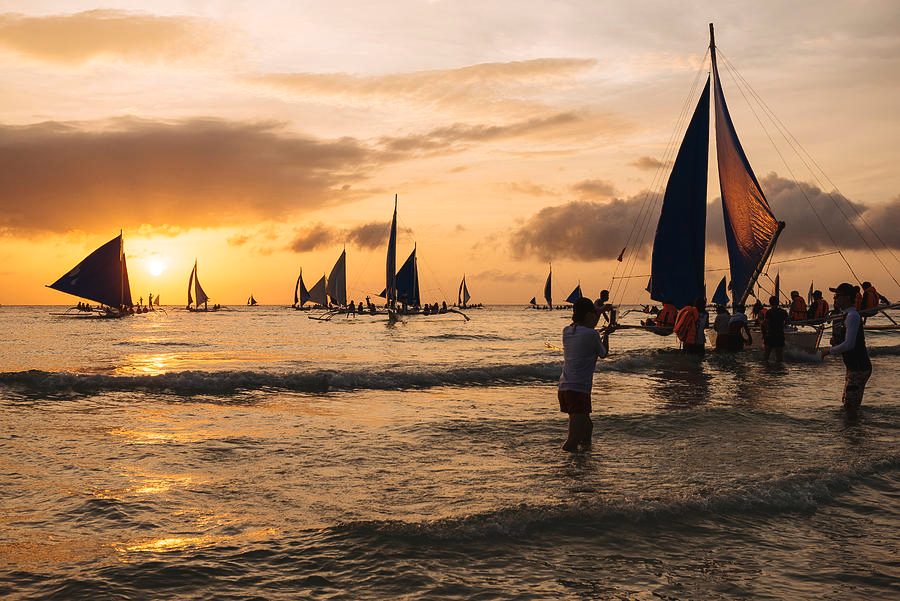
Paraw boats are narrow outrigger craft built for speed and maneuverability, not bulk capacity. Understanding weight restrictions before you book a sunset sail or island cruise ensures your group fits safely and the charter runs smoothly.
Quick answer
Most paraw boats on White Beach accommodate 4 to 6 passengers with a total weight capacity of 300 to 400 kilograms, depending on hull size and outrigger design. Operators assess combined passenger weight, gear, and sea conditions before departure. Solo travelers and couples rarely approach the limit, but groups of five or more should confirm capacity when booking, especially if carrying camera equipment or heavy bags.
Traditional paraw outriggers use bamboo outriggers and canvas sails tensioned across a narrow fiberglass or wood hull. The design favors agility over load-bearing, so weight distribution matters as much as total mass. A standard White Beach paraw measures four to six meters in length, with twin bamboo stabilizers lashed to each side. Operators space passengers along the central deck to keep the hull balanced and the outriggers from lifting out of the water during tacks. Boat weight restrictions for paraw sailing are enforced at the waterline, not through posted signage or ticketing tiers. Captains visually assess each group before pushing off, checking for uneven loading and asking heavier parties to redistribute or split into two boats. The paraw sailing boracay weight limit becomes especially relevant during monsoon season, when choppy water and stronger gusts reduce effective capacity by one or two passengers. Crews will not overload a boat in rough conditions, even if the group insists. Passenger limits also reflect crew positioning. Each paraw carries a captain who steers from the stern and a deckhand who manages the sail and assists with maneuvers. Their combined weight, plus safety equipment and anchors, consumes part of the rated capacity before the first tourist boards. Groups bringing snorkeling fins, waterproof bags, or tripods for sunset photography should mention these items when arranging the charter. Extra gear can tip a borderline group over the safe threshold. Operators along White Beach work with a mixed fleet, so capacity varies by boat. Newer fiberglass hulls with reinforced keels handle slightly more weight than older wooden craft. If your group includes six adults or anyone over 100 kilograms, ask the booking agent to assign a larger paraw or split the party across two boats. The cost difference is modest, and the experience improves when passengers have room to shift position during the sail.
“Weight distribution matters as much as total mass — captains space passengers along the deck to keep the hull balanced and the outriggers from lifting during tacks.”
The best time for paraw sailing is during the early morning for calmer waters or late afternoon for sunset, as wind strength directly affects boat stability and weight distribution. Sailing during these windows provides smoother conditions for passengers.
Dry, steady winds, 25-30°C
This season offers the most reliable sailing conditions for the paraw boats.
Occasional rain, gusty winds, 26-32°C
Sailing may be adjusted or paused if wind speeds exceed safety limits.
—
Lower wind speeds in the morning result in a more stable vessel for passengers near the weight capacity.
—
Arrival by 16:30 is recommended to secure a slot for sunset views while ensuring manageable water conditions.
Verdict: The best time to sail is weekday mornings or late afternoons during the Amihan season from November to May.
Paraw sailing operations in Boracay are available daily to accommodate visitors planning their maritime activities.
Paraw sailing in Boracay is a private boat charter activity, meaning there are no public gate or entrance fees. Costs are determined entirely by the private boat charter rate.
Verdict: While there is no entrance fee, visitors typically pay a set fee for a private boat charter, which fluctuates based on the number of passengers and the specific operator.
Paraw sailing activities depart from White Beach, Boracay Island, Malay, Aklan, Philippines. Visitors can easily access the shoreline on foot via various entry points connected to the island's main path.
Walk via Main Road to White Beach access points
Take an e-trike to the nearest station (e.g., Station 1, 2, or 3)
Private charter meeting points are located directly along the sand
Plan your arrival for the best sailing window between 09:00–17:30. If you wish to sail during sunset, ensure you arrive at the designated meeting point by 16:30.
Everything you need to know about paraw sailing boracay weight limit
Most operators do not have a single strict passenger weight limit but focus on the total capacity of the outrigger boat. The paraw sailing Boracay weight limit is managed by balancing the load to ensure the stability of the vessel on the water.
Operators typically distribute passengers evenly across the trampoline sides to maintain balance. Following the paraw sailing Boracay weight limit protocols ensures that the local boatmen can effectively navigate the traditional double-outrigger craft.
Children are included in the overall capacity count for the vessel. Parents should provide accurate headcount information when inquiring about the paraw sailing Boracay weight limit to ensure the boat remains within its safe operating threshold.
These traditional sailboats rely on precise weight distribution to prevent capsizing or uneven sailing. Adhering to established weight guidelines allows the crew to manage the sail and outrigger floats effectively during your island excursion.
If a group exceeds the standard capacity of the vessel, the operator will require the party to split into smaller groups or hire an additional boat. This measure is taken to maintain safety standards and ensure a comfortable experience for all guests on the water.
Safety is the primary concern for all boat operators on White Beach. Crew members will evaluate the total load before departure and may restrict passenger numbers if the total displacement exceeds the recommended limits for the boat size.